

A trading product connects an interface to a much larger operating system: account records, market data, order execution, funding, security, and customer support. A customer may see one confirmation screen, but several organizations and services may be involved in producing it. Building a dependable platform starts by making those responsibilities explicit. This guide follows a practical product and engineering plan, from defining the initial service to preparing the team that will operate it after launch.
What Is a Trading or Investment Platform and How Does It Work?
Trading interfaces and portfolio-management products
The platform is the part of the service that helps a customer understand an account, make a decision, send an instruction, and follow its outcome. It may connect to a broker for execution, a separate provider for prices, and other systems for identity checks or payment processing. A custom application does not automatically take over the responsibilities of those providers.
How market information and instructions move through the service
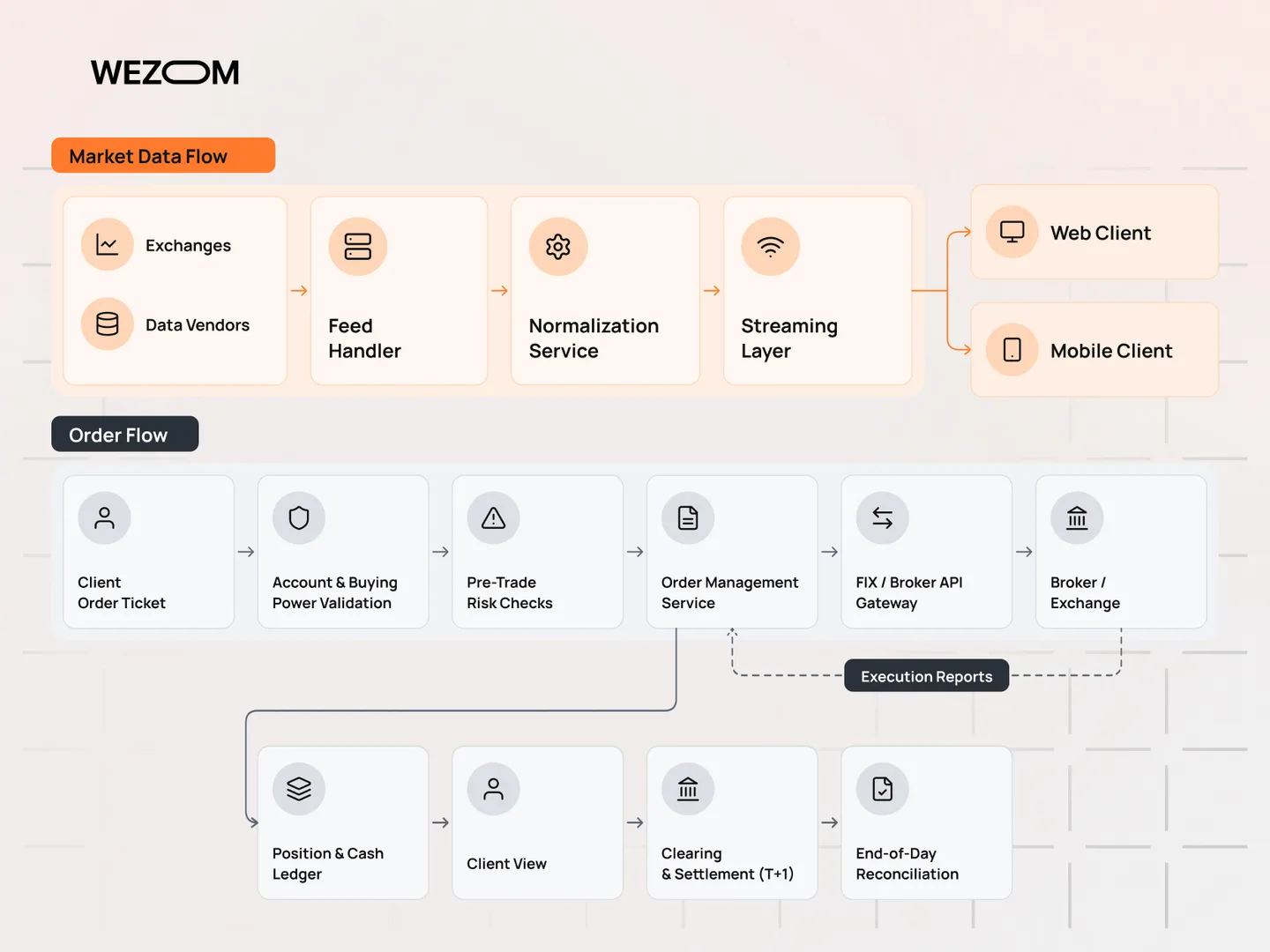
Start with a responsibility map. Identify the authoritative source for available funds, holdings, completed transactions, and customer permissions. Then describe how information reaches the interface and what the customer sees when a connection is delayed. That map prevents a common design mistake: presenting an optimistic local update as a confirmed financial event.
The needs of customers, brokers, and institutional teams
A retail customer may need a clear account view and straightforward instructions. An operations team may need reconciliation and exception handling. Institutional users may require delegated access and review workflows. Define the people using the product before treating them as one audience.
Custom software and an existing financial-service foundation
A custom application can connect to services supplied by partners. Identify which capabilities belong to your application and which remain with the provider, then assess the product against that arrangement rather than assuming the interface owns the entire financial service.
Choose the product model before the feature list
Write down the instruments, account types, operating markets, and supported devices for the initial release. Treat anything outside that boundary as a later decision. Adding an asset class can affect provider contracts, data fields, accounting rules, and support procedures as well as the screens, so it deserves a separate estimate rather than a checkbox in a backlog.
Equity and stock-trading workflows
Establish the supported instruments, account types, market information, and order capabilities with the chosen provider. Keep the initial experience focused on the intended audience, including understandable confirmations and records of earlier instructions.
Currency and digital-asset products
Different instruments can require different providers, data formats, availability assumptions, and operating arrangements. Review those dependencies individually instead of treating another asset class as a cosmetic change to an existing trading screen.
Automated and rules-driven instruction workflows
If the product submits instructions automatically, define who configures the rules, approves changes, and can pause the process. Include limits, investigation records, and recovery behavior in the requirements before implementing the automation.
Personal portfolio tracking
A portfolio product needs clear definitions for holdings, activity, value, and reporting periods. Identify the authoritative records and show useful timestamps so that a customer understands what the application is presenting.
Institutional account and reporting tools
Map delegation, review, reporting, and operational responsibilities with the intended team. Test how an authorized person investigates a discrepancy without granting unnecessary access to unrelated accounts or privileged actions.
A platform covering several asset classes
Treat additional instruments as a planned expansion of the operating model. Compare provider requirements, record structures, permissions, and support procedures, then decide what the first release can support completely.
Build the capabilities that make a complete service
A useful first release should support an entire customer journey. Map access, onboarding, account connection, funding visibility, research, instruction submission, account history, and help. The goal is not to include every advanced trading feature. It is to ensure that a customer can complete the promised task and understand what happens at every stage.
Access, onboarding, and account recovery
Design registration and recovery with the service’s identity and operating requirements. Define session expiry, permissions, and the route to support. Review the application and the connected identity systems together.
Market data, charts, and useful context
Show the age and availability of prices and distinguish information that is delayed or temporarily unavailable. Review the provider’s data agreement and ensure the interface does not imply that every displayed value is a current executable price.
Instruction entry and order status
Make the supported instruction types and their validation rules clear. Separate an instruction being received from it being accepted or executed, and provide a durable record that the customer and support team can follow.
Portfolio history and reporting
Define what each balance, holding, and performance figure represents. Keep the calculation assumptions and authoritative data sources documented so the team can explain a result and investigate a disagreement between records.
Limits, alerts, and exception handling
Agree what the product checks before accepting an instruction and which provider performs the final validation. Route exceptions to a named owner, with enough context to understand what happened and what the customer should do next.
Watchlists, research, and personal workspaces
Prioritize tools that support the intended customer journey. Keep research and user-created views distinct from authoritative account records, and provide understandable empty and unavailable states rather than filling every screen with speculative features.
Funding visibility and transaction records
Document which system owns the status of each movement and when it is considered complete. Customers should be able to distinguish a submitted request, a pending process, and a confirmed account record.
Capabilities for delegated and institutional users
Review permissions, approval requirements, exports, and exception handling with the people who use them. Advanced functionality should preserve a clear investigation trail rather than hiding complex responsibilities behind a broad administrator role.
Take the product from discovery to a controlled launch
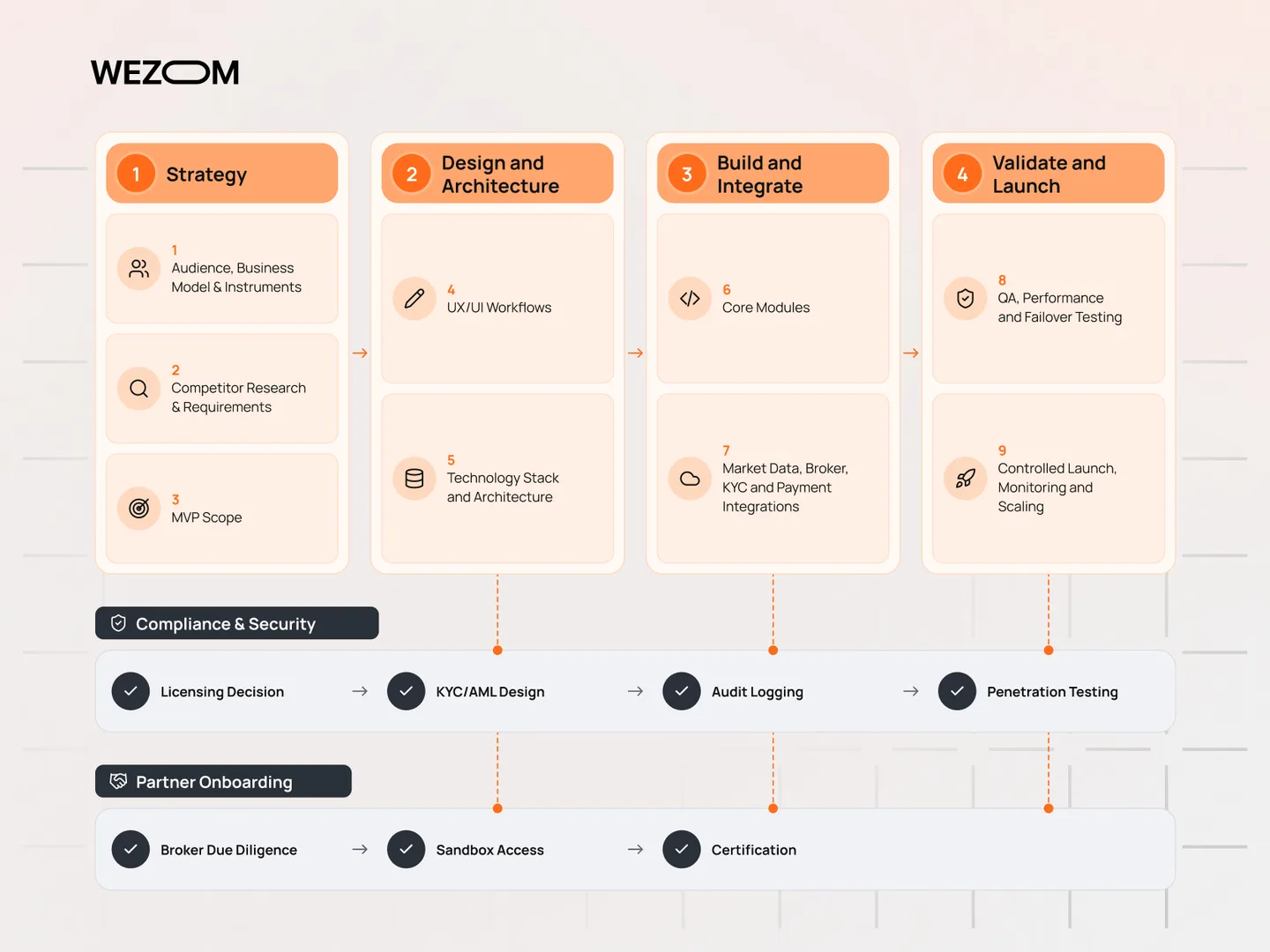
Begin with discovery and a clickable prototype, then investigate the most uncertain integration. Provider sandboxes, account-opening requirements, and production approvals can shape the entire delivery plan. A small technical exercise that follows one instruction through the connected systems is often more informative than several finished dashboard screens.
1. Define the audience, service, and supported instruments
Agree who the first release serves and the task it must complete. Identify the service partners and the responsibilities that remain outside the application before estimating the implementation.
2. Research the problem and document requirements
Interview the intended users and review the current process. Capture the records, approvals, waiting states, and support needs that a successful journey must handle.
3. Prioritize a complete initial product
Select an end-to-end journey with a practical finish line. Put optional instruments and advanced features into a later scope rather than weakening the reliability of the core.
4. Prototype the interface and uncertain states
Test the proposed interaction before building it. Include rejected instructions, delayed information, interrupted access, and recovery alongside the successful path.
5. Define interfaces and choose suitable technologies
Use integration requirements, team capabilities, and operating constraints to choose the architecture. Establish boundaries that make responsibility and failure recovery understandable.
6. Build account, order, and portfolio capabilities
Deliver an integrated slice rather than separate polished screens. Give each instruction and account change a traceable path through the application and connected services.
7. Validate third-party connections early
Exercise the actual sandbox and review production approval requirements. Record limitations and unresolved questions so that an integration assumption does not become a late launch surprise.
8. Implement the agreed security and operating controls
Turn the reviewed requirements into implementation and verification tasks. Keep specialist legal or regulatory decisions with the people responsible for approving the service.
9. Test recovery, performance, and complete journeys
Include provider interruptions, retries, incomplete results, and realistic load patterns. Confirm that operations can investigate a failure and that the interface describes its state accurately.
10. Release to a controlled audience and review outcomes
Next, build an end-to-end slice with its operational tools and acceptance checks. Review it with product, engineering, support, and the people responsible for the financial service. Expand only after the basic journey works under realistic conditions. Before release, rehearse an incident, a provider interruption, and a rollback so the launch plan describes decisions people can actually carry out.
Give the architecture clear boundaries and durable records
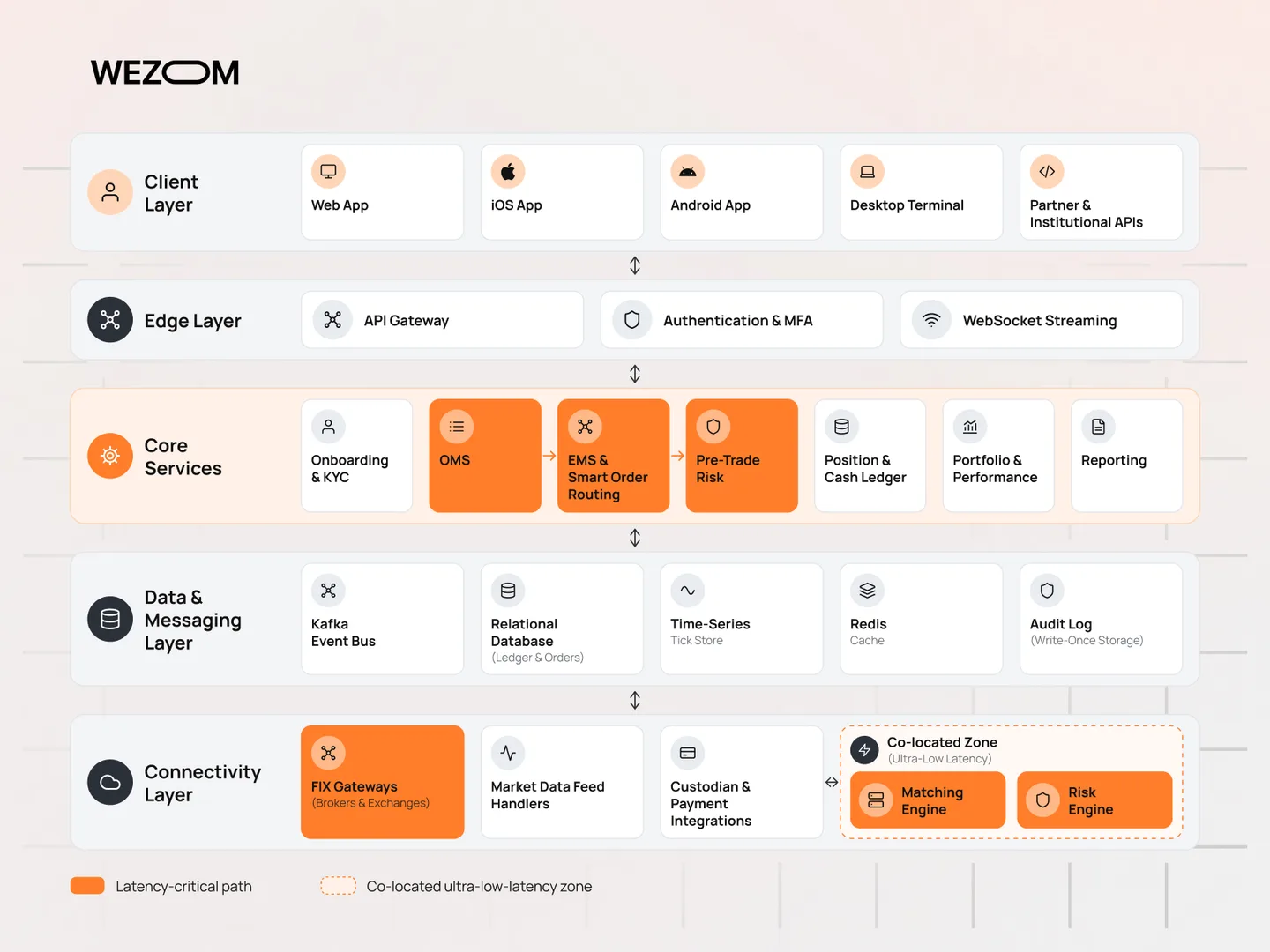
Choose technologies around team experience, integration requirements, and operating constraints. A modular application can be a sensible starting point when responsibilities are explicit; a large collection of independent services is not a requirement for a first release. Keep privileged provider credentials on controlled server interfaces and separate customer-facing requests from background reconciliation work.
Web and mobile client technologies
Choose a client approach that fits the supported devices, team skills, and required interactions. Keep privileged operations behind controlled server interfaces, and test access, interruption, and recovery across the complete journey.
Server frameworks and application boundaries
Separate responsibilities such as account access, instruction handling, reporting, and reconciliation through explicit interfaces. A modular application can make these boundaries clear without requiring a large collection of independent services from the start.
Records, caching, and event delivery
Decide which records are authoritative and how derived views are refreshed. Treat cache and event failures as expected operational scenarios, and preserve enough context to relate repeated or delayed messages to the original action.
Infrastructure and operational availability
Define the availability and recovery requirements before choosing a deployment pattern. Include observability, backups, release procedures, and an owner for each connected service rather than relying on infrastructure complexity as evidence of resilience.
Provider APIs and execution interfaces
Review each provider’s supported instructions, identifiers, error responses, and update channels. Prototype the uncertain connection early and keep its contract behind an interface that the application team can test.
Order lifecycle and execution records
Order handling needs a durable lifecycle rather than a single success flag. Alpaca's API, for example, assigns identifiers to orders and supports status updates through its streaming interface. Your application should relate incoming events to the original instruction, handle retries deliberately, and make incomplete processing visible to operations.
Latency and recovery under realistic conditions
Measure the complete user-visible path, including provider responses and data freshness. Agree how the product behaves when a deadline is missed, an update is delayed, or a connection becomes unavailable.
Make portfolio information explainable and reconcilable
The records behind a portfolio view
A portfolio view combines records that may change at different times. Holdings, unsettled activity, available funds, corporate actions, fees, and reporting currencies need defined meanings. Decide which values come directly from a provider and which the application calculates. Label timestamps and assumptions so a customer understands what a displayed total represents.
Allocation views and proposed changes
Distinguish a displayed allocation, a proposed change, and an instruction that has actually been submitted. Keep any automated action within an explicitly approved workflow with clear permissions and a way to pause it.
Performance calculations and reporting periods
Document the data and assumptions used in a performance view. Include the reporting period, currency, relevant cash movements, and treatment of missing information so the team can explain what the result represents.
Requirements for institutional reporting
Identify review roles, exports, account grouping, and the investigation process with the intended users. Test whether a person can understand a report and trace a discrepancy without depending on undocumented knowledge.
Connections to custodians and account-information systems
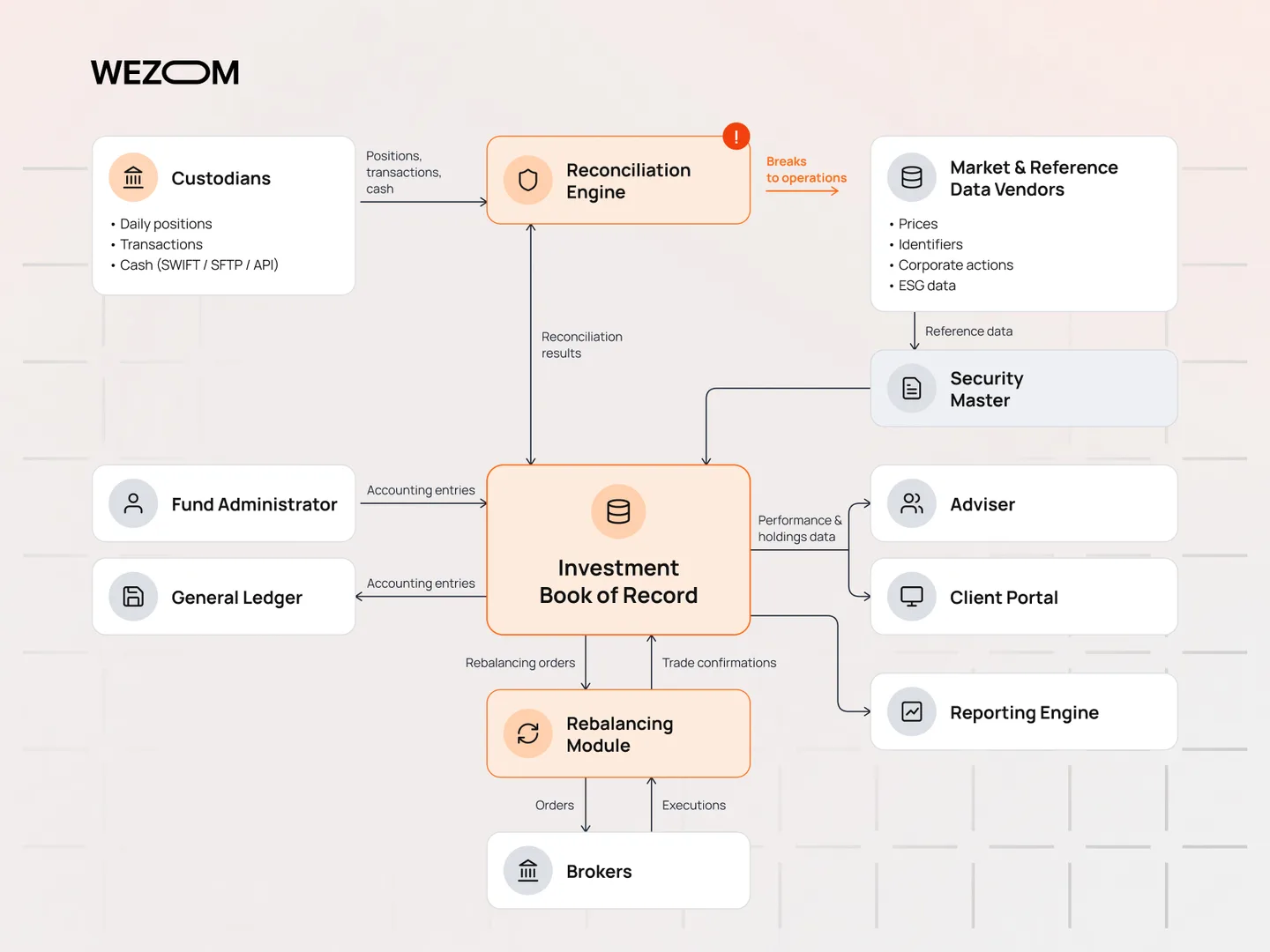
Treat reconciliation as a product capability. Operations should be able to compare internal records with provider records, identify an unmatched event, and follow a controlled correction process. Test account transfers, missing prices, repeated events, and changes to instrument identifiers. A chart that looks convincing is not a substitute for a record whose history the team can investigate.
AI-assisted analysis and explanations
Keep generated analysis separate from authoritative account data. An explanation can help someone understand a record, but it should not obscure where the figure came from or replace the approved process for an account action.
Translate security and operating obligations into checks
Access controls, sessions, and sensitive information
Review the application, connected services, and staff workflows together. Threat modeling should include account takeover, unauthorized access to records, fraudulent recovery requests, and misuse of privileged administration tools. Decide what information belongs in logs, who can read it, how secrets are rotated, and what happens when a session or integration credential is revoked.
Identity verification and the connected service
Confirm which organization owns identity checks and which information the application needs to handle. Design the handoff, incomplete states, and support route around that arrangement rather than duplicating an assumed process.
Requirements that depend on market and operating model
Identify qualified advisers and the partner teams responsible for the service’s legal and regulatory review. Convert their confirmed requirements into testable work without presenting a generic software checklist as an approval.
Custody, customer protection, and operating responsibilities
Make responsibility for funds, assets, records, and customer support explicit in the service design. Review the language in the interface so it accurately describes what the application and its partners do.
Audit records and controlled staff actions
Record enough context to relate important changes and instructions to an authorized actor. Review staff access and avoid exposing unnecessary customer information or credentials through investigation tools and logs.
Verification, recovery, and release readiness
OWASP ASVS offers a framework for defining and verifying application security controls. Use an agreed version and scope to make review requirements concrete. Regulatory and contractual responsibilities depend on the actual service and jurisdictions; identify the qualified advisers and partner teams who will resolve them instead of treating a security checklist as a legal approval.
Estimate investment from the confirmed scope
The requirements that drive the initial estimate
The main cost drivers are the number of complete workflows, integration uncertainty, account models, data requirements, verification work, and operational tooling. A price for a generic dashboard does not describe the cost of a trading service. Ask for an estimate that identifies assumptions, exclusions, partner dependencies, and the evidence needed to reduce uncertainty.
A focused release and a broader product roadmap
Estimate the first complete customer journey separately from later capabilities. Advanced reporting, new instruments, and more account types may introduce different dependencies and should not be hidden inside a generic feature allowance.
Retail and institutional workflow differences
Compare the actual permissions, reviews, records, and operational tools each audience needs. A screen count alone does not capture the work of delegated access or a more complex reconciliation process.
Provider access, data, and infrastructure charges
Request current terms from the relevant partners using realistic usage assumptions. Include the cost of testing and operating the integrations rather than considering them a one-time development task.
Maintenance and continuing operation
Separate initial delivery from recurring operation. Market-data access, provider services, infrastructure, monitoring, maintenance, and support can continue after launch. Compare proposals against the same customer journey and acceptance criteria. Discovery should produce a clearer scope and a more useful estimate, rather than a promise that every unknown will fit inside an early fixed figure.
Reduce uncertainty before reducing the scope of verification
Investigate the riskiest dependency early and use evidence to refine the plan. Protect the checks and operating tools that make the initial journey dependable, then postpone optional functionality where necessary.
Plan the schedule around dependencies and release gates
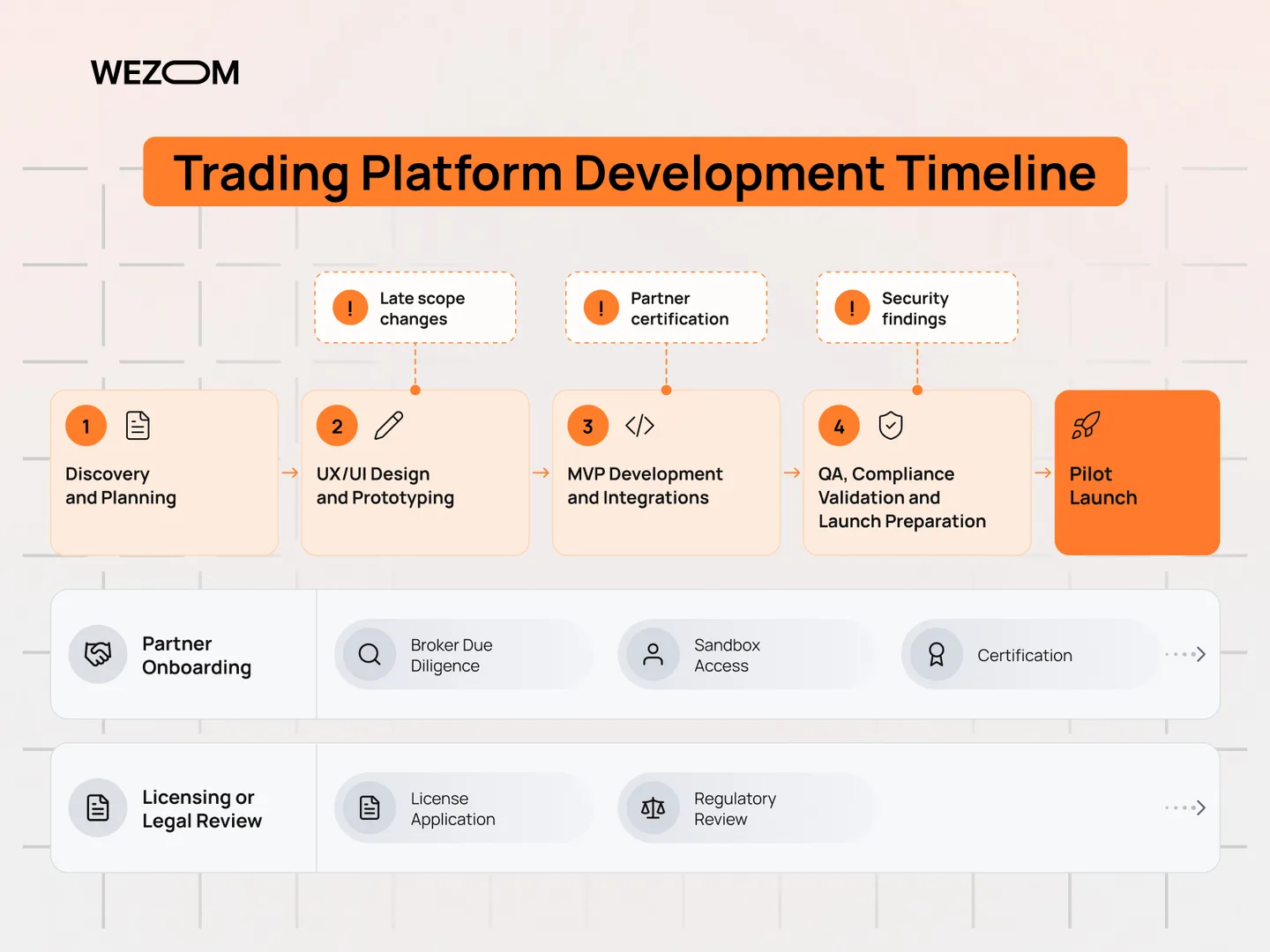
A delivery calendar should show more than design and coding. Include provider access, sample data, production onboarding, security review, support preparation, and the release decision. Put an owner and an expected response time against each external dependency. Otherwise the team can finish its implementation and still be unable to launch it.
Discovery and technical investigation
Use this stage to confirm the audience, operating arrangement, partner access, and unresolved technical questions. Its output should make the next estimate more specific and expose dependencies that need an owner.
Interaction design and prototyping
Test the proposed workflow with realistic waiting and failure states. Resolve unclear responsibilities and wording before they become expensive changes to an implemented product.
The initial release and its integrations
Plan milestones around complete working behavior. Track provider access, test data, and production approvals alongside implementation so external work remains visible in the schedule.
Verification and preparation for launch
Use milestones that demonstrate working behavior: a verified account connection, a complete instruction lifecycle, a reconciled account record, and a rehearsed recovery procedure. Track which uncertainties have been resolved at each milestone. A staged release to a limited audience creates a clearer learning loop than making the entire business plan depend on one large launch.
Dependencies that can extend the calendar
Changes to account requirements, integration limits, approval processes, or the supported audience can affect more than coding time. Record assumptions and review their status at each milestone instead of treating the first calendar as a guarantee.
Compare a custom build with a partner platform fairly
The control offered by a custom application
Custom development can shape the user journey, application interfaces, and operational tooling around a defined requirement. That flexibility also creates responsibility for maintenance, verification, documentation, and the application’s continuing operation.
The boundaries of a partner or white-label product
Demonstrate the difficult workflow and review its supported configuration, data access, and change process. Identify where a requirement becomes custom integration work rather than assuming the existing product already covers it.
A fair comparison of launch speed and operating work
A partner platform may already provide useful workflows, while a custom interface can offer more control over the customer experience and integrations. Compare both approaches using the same requirements. Demonstrate the difficult journey, review the available data exports, and understand how the service behaves when a feature or connection is unavailable.
Ownership and the ability to change direction
Evaluate ownership as carefully as launch speed. Review access to source code where applicable, deployment rights, operating responsibilities, change procedures, and the ability to move records to another system. An apparently quick route can become restrictive when the product needs a new workflow, so ask how that change would be delivered before choosing the foundation.
Resolve the failure cases that undermine customer trust
Data freshness and uncertain execution states
Many difficult issues sit between systems: a customer repeats an instruction after a timeout, the provider accepts it after the interface gives up, or an update arrives before a related account event. Make those scenarios explicit. Store enough context to relate retries and messages, and define how the application moves from an uncertain state to a confirmed one.
Busy periods and provider interruptions
Test meaningful load patterns and define the product’s behavior when a connected service slows down. Include staff alerts, understandable customer states, and a practical recovery decision rather than relying only on a capacity estimate.
Several providers and inconsistent event formats
Normalize external responses behind explicit interfaces while preserving the original context needed for investigation. Account for delayed, missing, and repeated messages in the application’s lifecycle model.
Changes to operating requirements across markets
Review the intended service and market with the responsible advisers and partners before expanding. A new operating arrangement can affect account access, records, customer communication, and release approvals.
A clear interface for complex workflows
Use language that matches the underlying state. Customers should not need to infer whether an instruction was completed from a spinner, and support should be able to explain the record behind the message.
Advanced features without losing core reliability
Test with incomplete and delayed information instead of only ideal sandbox responses. Include partial outcomes, revoked access, provider maintenance, and interrupted network connections. Give support an investigation trail and clear customer wording. An honest pending state is more useful than a confident confirmation that the underlying system has not earned.
Choose a team that can explain its engineering decisions
Engineering expertise beyond a framework list
Ask a potential development partner to walk through the order lifecycle, reconciliation process, access model, and release procedure. Look for concrete examples of how the team investigates errors and tests integrations. A list of frameworks says little about whether the team can deliver an understandable and maintainable financial product.
Evidence of work on the relevant workflows
Ask the team to explain how it models instructions, tests permissions, reconciles records, and prepares operations. Concrete examples of investigation and recovery are more informative than unsupported claims about industry expertise.
Questions that make a proposal reviewable
Request the scope, assumptions, dependencies, acceptance criteria, and unresolved questions in a form the team can discuss. A useful proposal should make the expected behavior and ownership easy to assess.
A team structure with clear decisions
Agree who is responsible for product priorities, architecture, implementation, specialist reviews, and operating handover. The delivery arrangement should make escalation and approval practical across the people involved.
The agreements and handover plan
Agree who owns product decisions, architecture, security review, documentation, deployment, and ongoing support. Request a practical handover plan and access to the working project throughout delivery. The strongest proposal should make both the planned behavior and the unresolved questions easy to assess, without replacing uncertainty with unsupported claims about speed or savings.
Leave room for future capabilities without weakening the core
AI-supported research and analysis
Personalized research, automated reporting, new instruments, and AI-assisted support may become useful additions. Evaluate each against a customer problem and an operating owner. Keep generated explanations separate from authoritative account records, and make the source of a financial figure clear regardless of how the interface presents it.
Automated portfolio and reporting workflows
Evaluate an automated capability against a customer problem and an approved operating process. Define who reviews its configuration, what it can change, and how it is paused or corrected.
More personalized investing experiences
Separate useful personalization from the records and disclosures that every customer needs to understand. Confirm that a tailored interface still communicates the status and source of important account information clearly.
New instruments and infrastructure choices
Review provider capabilities, record structures, permissions, and support responsibilities before adding a new instrument or integration model. Validate the uncertain part as a focused expansion rather than assuming it fits the existing workflow.
A core that can support future connections
A well-defined core makes change easier: explicit interfaces, traceable instructions, tested permissions, and reconciled records. Add one capability at a time and measure whether it improves the intended journey. The product should become more useful as it grows while preserving the team's ability to explain what happened when a customer asks a difficult question.
FAQ
Does building a trading interface make the operator a broker?
An interface and the financial service behind it are different parts of the operating model. Identify what the business and its partners actually do, then have the responsible advisers confirm the applicable requirements before designing the service around an assumption.
How does the application differ from the brokerage service?
The application provides the customer or staff workflow. A connected provider may supply execution, custody, account infrastructure, or other capabilities. Define the boundary and the source of each authoritative record explicitly.
Can one product support several asset classes?
It can be planned that way, but each class can introduce different providers, record structures, permissions, and operating processes. Validate one complete journey first and estimate additional instruments as a deliberate expansion.
How should the business model affect the product plan?
Document which capabilities the business intends to offer and how it will charge for them. Review partner contracts and relevant requirements with the responsible specialists, then make the application accurately communicate the agreed arrangement.
Is direct connectivity to an exchange always necessary?
The architecture depends on the service and chosen partners. A provider API may supply the capabilities an application needs. Review supported instruments, instructions, data, production access, and operating responsibilities before committing to a particular connection.
Can an existing investment application be improved in stages?
Start by mapping its records, interfaces, customer journeys, and operating dependencies. Identify a bounded improvement that can be verified and released safely, while preserving a clear migration and recovery plan for the remaining system.
What should be agreed about source code and project ownership?
Agree access, ownership, licensing, deployment rights, third-party components, documentation, and operating handover in the project arrangements. Have the relevant contracts reviewed by the people responsible for those decisions rather than assuming every component has the same terms.
How can an idea be tested before a full implementation?
Interview the intended users, prototype the complete journey, and investigate the riskiest provider connection in a suitable test environment. Use those findings to confirm the scope, dependencies, acceptance criteria, and operating model.