

PHP2Shell is the name used for two critical PHP runtime vulnerabilities disclosed in October 2026. A useful response needs to answer three separate questions: which running systems are affected, whether the supported fixes have reached those systems, and whether there is evidence of earlier unauthorized activity. Keep the upstream advisories and your hosting or operating-system vendor's guidance beside the response plan. A CMS update, a firewall rule, and a runtime patch are different controls and should not be confused with one another.
Understand the two runtime issues before assessing exposure
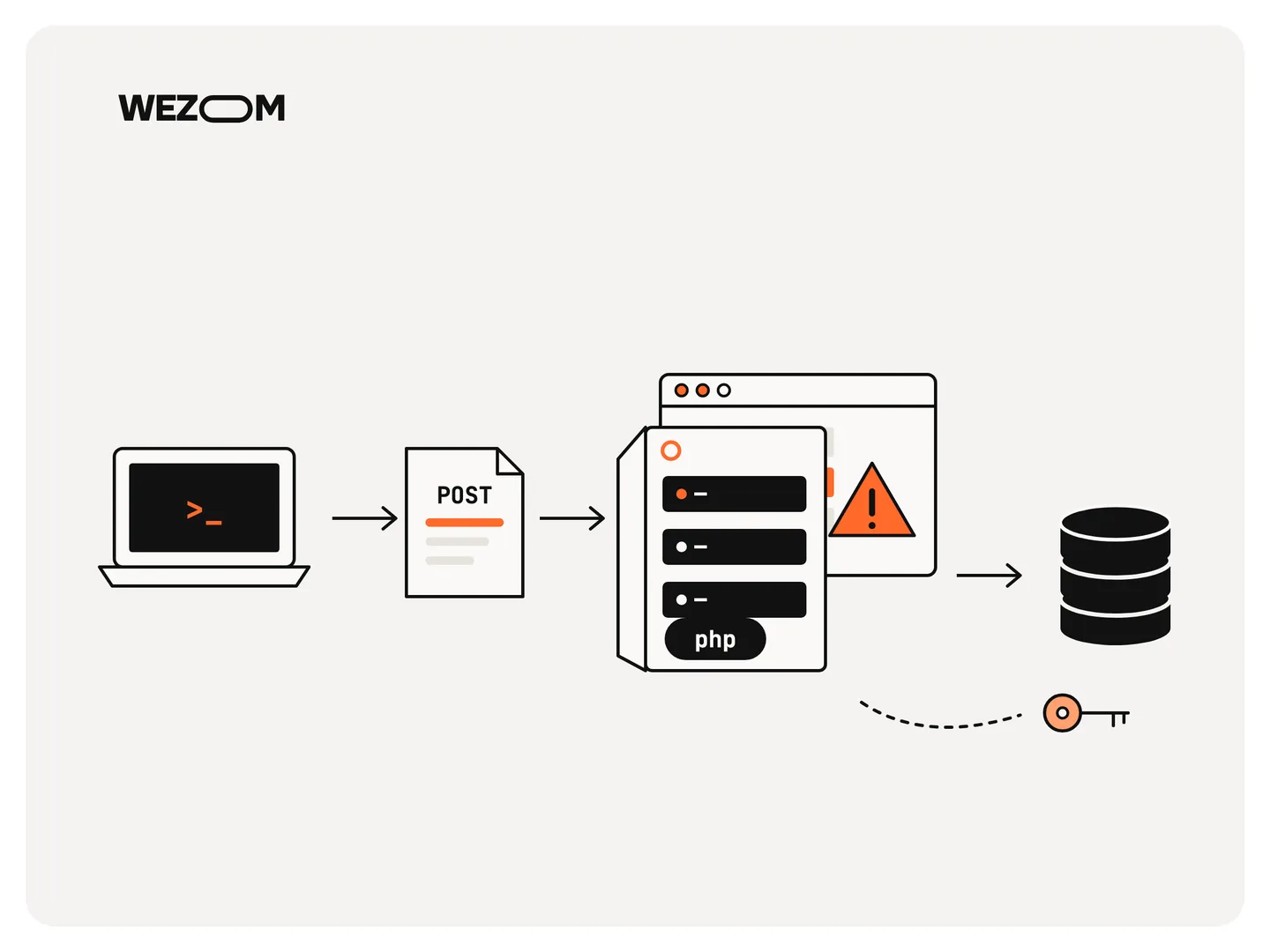
The PHP project published critical advisories for CVE-2026-109618 and CVE-2026-109619 on October 21, 2026. The first concerns memory corruption during out-of-memory handling; the second concerns request-owned data remaining reachable through stale global state. Under affected conditions, the issues can lead to remote code execution. The exact exposure depends on the runtime, request handling, and configuration described in the advisories.
Treat a runtime vulnerability as separate from an application bug. Changing a plugin or validating an application form does not replace the applicable PHP fix. The upstream out-of-memory advisory specifically states that an updated PHP release containing its patch is the complete mitigation. Use vendor-supported packages or images and verify what the running services use after deployment.
Review the exposure window as well as the patch date
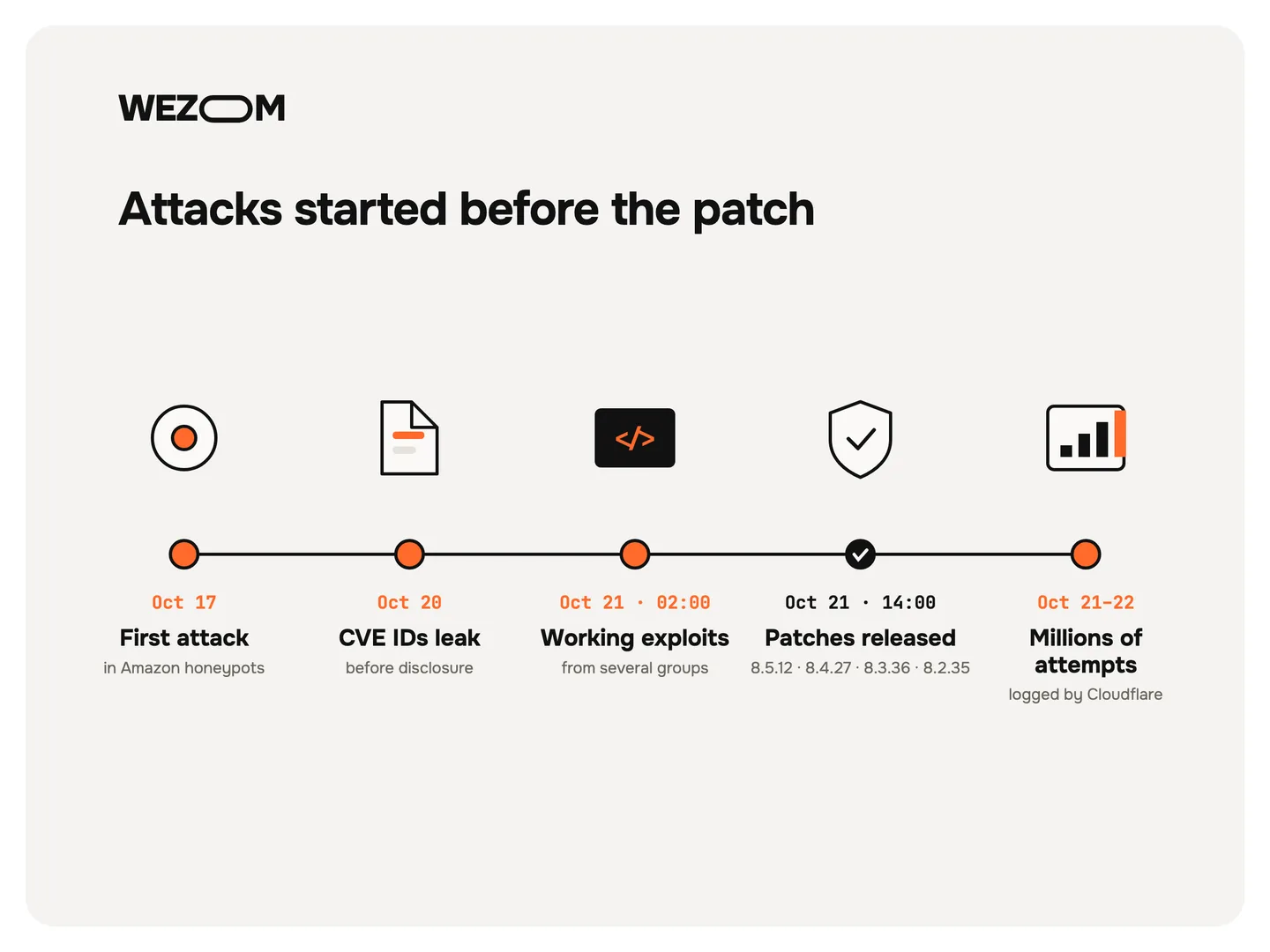
Amazon Threat Intelligence reported an exploitation attempt observed in its MadPot environment on October 17, before public disclosure. Cloudflare also reported activity around the disclosure and deployed WAF protections. Those vendor observations explain why a successful update and an investigation answer different questions: an update changes the vulnerable runtime, while an investigation examines activity that may already have occurred.
Build a timeline for your own systems. Record when each environment was reachable, which runtime it used, when protective controls changed, and when an updated worker or image entered service. Preserve the logs and deployment records needed to review that period. Missing evidence should remain an explicit limitation rather than becoming a statement that nothing happened.
Find every environment and establish its patch status
Inventory production workers, staging copies, administration tools, older sites, containers, and scheduled processes. Record the deployment owner and package or image source for each system. Ask managed-service providers which components they update and what evidence they can supply. A list of application repositories is not necessarily a list of all running PHP environments.
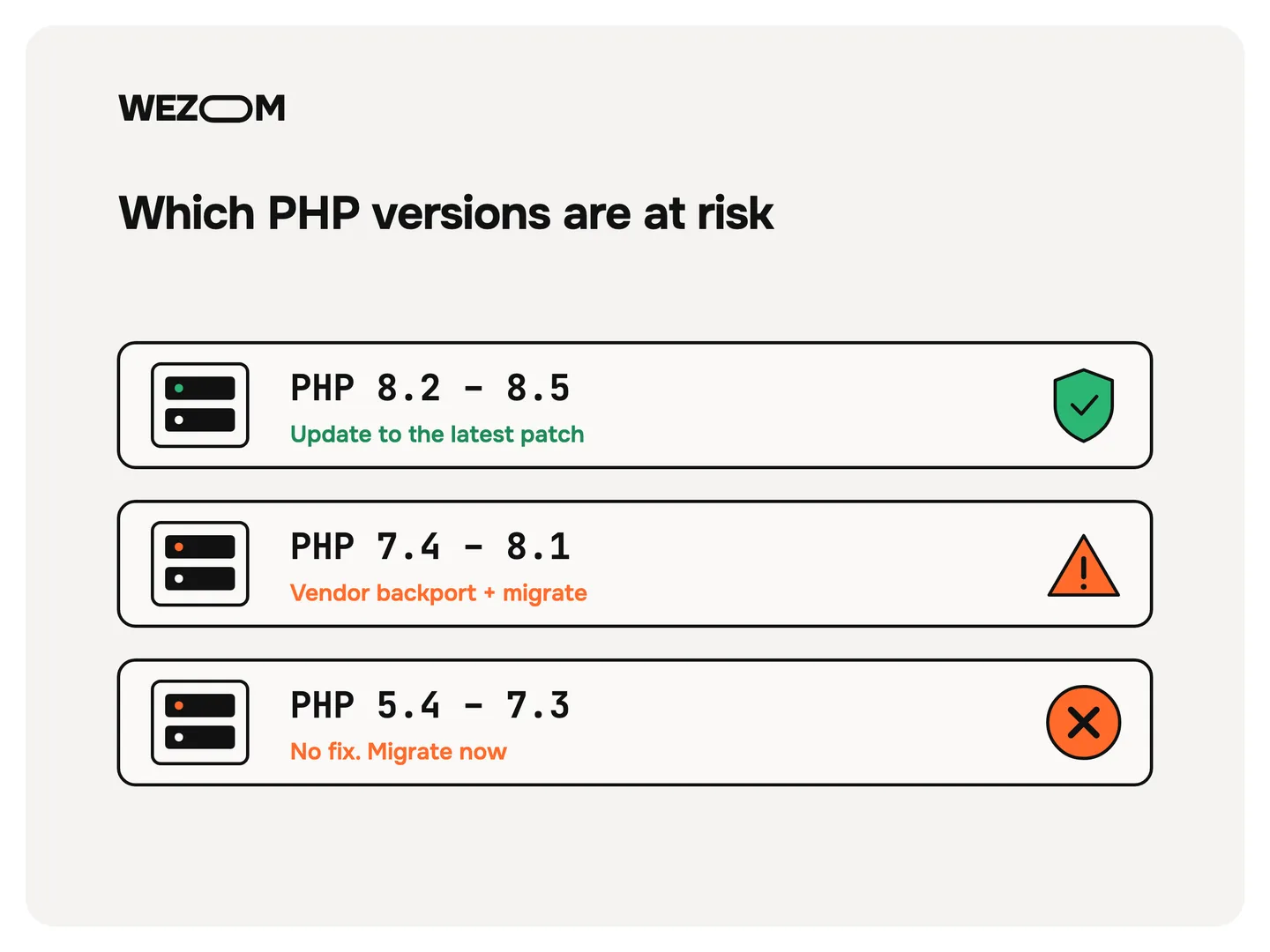
The two original advisories list the releases below as patched versions. Downstream vendors may provide supported backports, so use their advisories to interpret their package versions. Unsupported branches need an upgrade plan rather than an assumption that an old application is protected because it still functions.
| PHP branch | First patched release listed for the original two issues |
|---|---|
| 8.2 | 8.2.35 |
| 8.3 | 8.3.36 |
| 8.4 | 8.4.27 |
| 8.5 | 8.5.12 |
Assess the business impact through the affected worker's access
Prioritize systems by exposure and the resources their application accounts can reach. An affected web worker may have access to application records, files, session information, or integration credentials. Review the actual permissions and connected services instead of treating every installation as an identical incident. Separate confirmed findings from possible consequences while the investigation is underway.
Bring the right owners into the response. Operations may need to coordinate a maintenance window; application teams need to verify important journeys; security specialists assess suspicious activity; business and legal teams handle their respective communication and reporting decisions. Keep a shared record of findings, unresolved questions, and the person responsible for the next action.
- Identify the customer-facing workflows that would be disrupted by an emergency change.
- Review what each application identity can read, modify, or call through an integration.
- Preserve relevant access records, application logs, image details, and deployment history.
- Escalate evidence of unauthorized changes through the organization's incident-response process.
Combine a verified rollout with a separate investigation
Prepare recovery material, test the supported update path in a representative environment, and agree how the deployment will be approved. After rollout, verify the workers and replicas handling requests, then exercise sign-in, important forms, background tasks, and key integrations. Installing a package alone does not demonstrate that every active service is using it.
Keep checking current notices. Cloudflare's October 23 update describes a related issue, CVE-2026-115560, in session upload progress that affects releases including PHP 8.5.12. The original two fixes therefore do not settle every subsequent advisory. Review the current PHP and vendor guidance for the deployed configuration before closing the response, and do not treat a WAF rule as evidence that the runtime no longer needs attention.
Define a security review with clear evidence and deliverables
Deliverables from a clearly scoped initial review
A focused review should produce an environment inventory, a patch-status assessment, findings that can be traced to evidence, and a prioritized action plan. Agree the systems, access, retention period, and investigation depth before assigning a turnaround time. An initial review and a complete compromise investigation are different scopes and should be described separately.
- An environment inventory with deployment and maintenance owners.
- A patch-status assessment tied to applicable upstream and vendor guidance.
- Evidence-backed findings, remaining uncertainties, and prioritized next actions.
Follow-up remediation and continuing maintenance
After the immediate work, keep the inventory alive. Assign owners to runtime upgrades, image rebuilds, advisory review, and retirement of obsolete environments. Retain a repeatable verification checklist with the application so that the next urgent update begins with known responsibilities instead of a search for forgotten infrastructure.
- A supported update plan with application checks and deployment verification.
- An incident investigation when the evidence and exposure require one.
- Maintained records for advisory review, recovery, and retirement of old environments.
FAQ
Does updating WordPress, Magento, or a framework update PHP too?
Not necessarily. The application and the runtime are separate components. Establish which PHP package or image is actually running and follow the relevant application, hosting, and operating-system guidance.
Can a managed host confirm that an environment is fixed?
Ask the provider for its applicable advisory, package or image details, rollout status, and the responsibilities that remain with your team. Do not infer patch status from a general statement that the server is managed.
Is a web application firewall enough?
Treat WAF protections as a separate layer. The PHP out-of-memory advisory identifies an updated runtime containing its patch as the complete mitigation for that issue. Follow current upstream and vendor guidance for the full response.
Does a successful update rule out an earlier compromise?
No. Deployment verification establishes what is running now. Investigating earlier activity requires the available logs, deployment history, affected permissions, and an appropriate incident-response scope.
Can every environment be reviewed within a fixed number of hours?
The scope depends on the number of systems, available access, evidence retention, application complexity, and required investigation depth. Agree those details before committing to a timetable or promising a complete result.