


A useful banking app makes the movement of money understandable. Customers need to know which balance they are seeing, whether a payment has completed, and how to get help when something is wrong. Delivering that experience takes more than mobile screens: identity, account records, payment providers, operations, and support must work as one service. This guide explains the product and engineering decisions to resolve before estimating or building it.
What building a mobile banking service involves
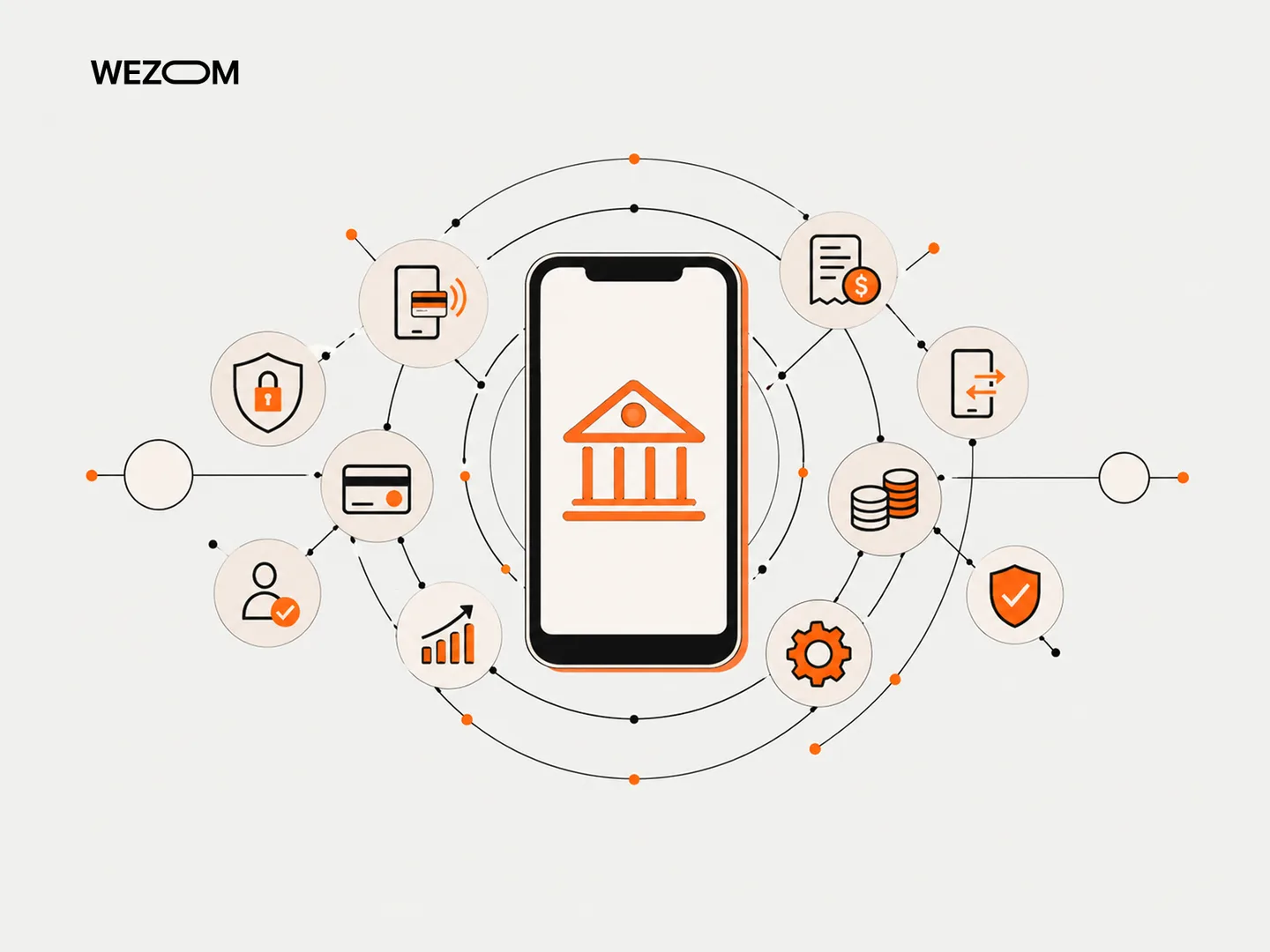
Mobile banking development connects customer journeys to the systems that hold accounts and process financial activity. The app may present the experience, while a bank, payments partner, or core platform owns the authoritative account record. Define those responsibilities before deciding which features belong in the first release.
Start with one audience and a clear service boundary. An existing bank adding a mobile channel faces different integration work from a new product using a banking partner. Write down supported account types, launch markets, operating hours, and the people responsible for exceptions. Those decisions shape the architecture and the delivery plan.
The request behind a banking screen
A balance screen requests account information through an authenticated service. The authoritative account system supplies the record; the app must present its timestamp and explain any difference between available and pending amounts.
A mobile channel and a wider banking platform
The mobile client is one channel within a service that may also include web access, staff tools, payments, and reporting. Define which capabilities belong to the shared platform and which are specific to a device.
When a custom app is justified
A custom banking app should be justified by a service requirement that an existing solution cannot adequately support.
A custom implementation may be useful when existing products cannot support the required customer journey or integration. Compare that need with the responsibility of maintaining the result rather than assuming custom development is automatically preferable.
Different banking product models
An established bank, a partner-backed fintech, and a digital-asset service can present similar screens while owning different operations. Describe the operating model before estimating features or adopting an architecture from another product.
The customer journeys a banking app needs
Choose complete journeys rather than collecting isolated features. A transfer flow includes selecting a recipient, checking details, authorizing the instruction, seeing its status, and finding its record later. A customer who loses connectivity midway still needs an answer without accidentally submitting the same transfer again.
Balance everyday convenience with the support needed when something unusual happens. Make timestamps, account restrictions, service messages, and the route to help visible in context. The following capabilities provide a practical starting point for discovery.
Joining and verifying an account
Design registration as a supported journey with clear document requests, progress states, and recovery from an interrupted session. Agree with the identity provider how a result is reviewed and how an unsuccessful applicant receives help.
Balances with a clear source and timestamp
Distinguish available funds, posted activity, and pending instructions using the account provider’s definitions. A refresh indicator should describe the information’s state rather than imply that every connected system updates simultaneously.
Transfers between people and accounts
Confirm the recipient, amount, currency, fees where applicable, and authorization before submission. Retain the instruction identifier so an interrupted app can retrieve its status instead of asking the customer to submit it again.
Bills, recurring instructions, and scheduled activity
Show when a scheduled action is expected to run and which changes remain possible. Explain what happens when funds are insufficient or a connected provider is unavailable at the scheduled time.
Physical and virtual card controls
Confirm which controls the issuing partner exposes before designing card freezing, limits, or replacement. Show pending requests accurately; a mobile switch should not claim completion before the issuer confirms the change.
Finding transactions and downloading records
Provide search and filters that match the customer’s questions, such as a date, merchant, recipient, or status. Keep statements and exports consistent with the account system’s recorded values and supported formats.
Notifications that lead to useful context
A notification should take the customer to the relevant account activity after appropriate access checks. Avoid including sensitive information in lock-screen messages, and let customers manage optional notification preferences.
Spending summaries and budgeting tools
Explain categorization and let customers understand the period being summarized. Treat inferred categories as interpretations that can need correction, especially when the merchant or payment description contains incomplete information.
Support inside the app
Offer a secure route from the problem screen to a support conversation with the necessary context. Define what staff can inspect and which account changes require a separate authorized workflow.
Personalized and assisted experiences
Assess an assistant against a bounded task, such as locating a statement or explaining a recorded payment state. Keep generated explanations distinct from verified account data and restrict actions through explicit permissions.
Make mobile security a design requirement
OWASP MASVS groups mobile verification work into areas such as local storage, cryptography, authentication, network communication, platform interaction, resilience, and privacy. Use those categories to create concrete acceptance criteria. A broad promise that an app is secure does not tell a team what to implement or an assessor what to verify.
Keep privileged operations and service credentials behind controlled server interfaces. Review what remains on the device after logout and how sessions end. Android Keystore can protect non-exportable cryptographic key material and restrict its use; using a platform facility still requires a considered key lifecycle and recovery design.
Authentication factors and device biometrics
Define which actions need additional verification and how the customer recovers access when a device is lost. Biometrics can assist a local access step, but the complete account-recovery process still needs a deliberate design.
Protecting stored and transmitted information
Document the data that moves between components and what remains on the device. Select protection mechanisms with the security team, then test configuration and lifecycle behavior rather than treating encryption as a checkbox.
Access checks at the API boundary
Authorize each request against the account and operation involved. A hidden interface control is not an access boundary; test whether a modified client can request another customer’s records or a privileged action.
Device relationships, sessions, and token expiry
Specify how a device becomes associated with an account and how that relationship ends. Test session expiry, logout, token replacement, and loss of connectivity so the interface does not misrepresent continued authorization.
Transaction risk and monitoring workflows
Keep risk decisions connected to transaction states and the people who review them. Describe the customer response to a challenged instruction and ensure that support can investigate the decision through authorized tools.
Signals from a potentially compromised device
Decide how device-risk signals influence the service and how false alarms are handled. Avoid presenting any single local check as proof that a device or account is safe.
Local storage and sensitive screen content
Limit cached information to what the experience actually needs. Review backups, screenshots, notifications, logs, and clipboard use as potential copies of sensitive information, not only the app’s primary database.
Assessment and vulnerability response
Agree the mobile assessment scope and the process for resolving findings before release. Maintain ownership for dependency advisories, runtime updates, and reassessment after material changes to the application or its integrations.
Security events that operators can use
Record relevant access and privileged actions without placing secrets in logs. Give alerts a destination, an owner, and a response procedure; collecting an event is different from detecting and addressing a problem.
Translate operating obligations into delivery work
The obligations that apply to a banking service depend on its activities, customers, partners, and jurisdictions. Have the responsible compliance and legal specialists identify them, then turn their decisions into product requirements, evidence, and named owners. A development framework or security checklist is not a substitute for that review.
Keep a traceable record of why data is collected, who can access it, how long it is retained, and how a customer request is handled. Include partner approvals and release evidence in the delivery schedule. Discovering those dependencies only before launch makes otherwise finished software difficult to release.
Identity and suspicious-activity responsibilities
Have the responsible specialists define the identity and review obligations for the service. Translate their decisions into provider contracts, staff workflows, evidence, and escalation paths instead of embedding unexplained checks in the mobile interface.
Card-data scope and assessment
PCI SSC publishes standards for protecting payment account data. Ask the appropriate assessor which systems and data flows are in scope, including connected services, before making architecture or evidence assumptions.
Personal information and customer rights
Create a data inventory with a named owner for each purpose and retention decision. Have privacy specialists review access, correction, deletion, and support workflows for the markets the product will actually serve.
Open-banking access and authorization
Confirm which rules and provider agreements apply to account access or payment initiation in each market. Make customer authorization, expiry, revocation, and renewed access explicit parts of the integration design.
Market-specific requirements and data location
Record the requirements identified by the accountable advisers for each launch market. Include where operational, test, analytics, and support data may be processed; infrastructure location alone does not describe every data flow.
Evidence throughout the delivery lifecycle
Attach requirements to acceptance criteria and retained evidence. Include reviews and partner sign-offs in the release process so compliance work develops alongside the product instead of arriving as an unexplained final gate.
Connect the app to the systems behind the account
Map account authority and every external dependency before polishing the screens that rely on them.
Separate the mobile interface, customer-facing APIs, identity services, transaction workflows, and operational tools through explicit contracts. This does not require dozens of microservices. It requires clarity about who owns a record, how an instruction is identified, and which component can authorize a change.
Model timeouts, duplicate requests, and out-of-order events in the integration design. A payment provider accepting an instruction is different from a payment completing. Store enough history to reconcile those states and investigate a customer report. Keep support access limited to the information and actions each role actually needs.
Responsibilities across client and server
Keep account authority and privileged actions on controlled services. The client should render and submit supported instructions, while server components apply the relevant permissions and preserve the record needed to reconcile results.
Connecting the core account platform
Test the core system’s contracts using realistic account and transaction states. Confirm freshness, pagination, identifiers, and error behavior so the mobile design reflects what the authoritative platform can reliably provide.
Payment processors and networks
Define the lifecycle of a payment across each provider boundary. Reconcile acknowledgments, later status events, cancellations, and refunds according to the connected service rather than treating a successful HTTP response as settlement.
Identity-provider decisions and exceptions
Document how verification requests, manual reviews, and provider outages appear to customers and staff. Keep sensitive documents and reviewer permissions within an agreed access and retention model.
External account and consent integrations
Model consent as a record with scope, duration, and revocation behavior. Test what the app displays when access expires or a provider can no longer return the requested account information.
Risk screening and investigation tools
Give risk services defined inputs, result meanings, and availability expectations. Connect referrals to an owned investigation workflow, including a record of why an instruction was restricted or released.
Lending and eligibility services
If the product includes lending, separate application collection, specialist decisioning, account administration, and customer communication. Have the responsible team approve the information shown about eligibility and the explanation of an outcome.
Customer records and operational analytics
Share only the information each staff or analytics workflow requires. Define how consent, retention, and account changes propagate to connected customer-service systems and reports.
API contracts that can evolve safely
Version and test contracts around clear business operations. Use request identifiers and documented error states so mobile releases, provider updates, and operational investigations remain understandable across different release schedules.
Choose the mobile stack around real constraints
Choose a stack that the team can verify, operate, and maintain throughout the life of the service.
Compare native and shared-code approaches using the capabilities the product needs: device integration, accessibility, secure local storage, supported operating systems, performance, and release management. The cheapest screen implementation can become expensive if a required identity or payment SDK is poorly supported.
Prototype uncertain integrations before standardizing the stack. Check the team's ability to maintain platform-specific code, diagnose device problems, and update dependencies. Include the backend, test infrastructure, observability, and deployment process in the decision; a mobile framework is only one part of the service.
Separate iOS and Android implementations
Evaluate platform-specific development when the required device behavior or SDK support warrants it. Include the effort of maintaining two release processes, accessibility implementations, and diagnostic paths in the comparison.
Flutter and React Native as shared-code options
Validate required identity, payment, and device integrations in a small working application before choosing a shared-code framework. Count platform-specific maintenance and dependency ownership alongside the amount of interface code shared.
Backend languages and service ownership
Choose backend technology that the operating team can support and diagnose. Assess integration libraries, transaction handling, deployment, and maintenance needs rather than selecting a language solely for a benchmark or hiring trend.
Databases and authoritative financial records
Separate financial records from caches, search indexes, and analytics stores. Define consistency and reconciliation requirements before choosing storage products, and test the recovery path for each kind of record.
Hosting location and operational responsibilities
Compare cloud and existing infrastructure against the product’s access, recovery, data, and operational requirements. Include the people and procedures needed to operate the chosen environment, not only its provisioning cost.
A modular application or multiple services
Use boundaries that clarify ownership and change. Independent services add operational work; a well-structured application can be a practical starting point when it meets the product’s isolation and delivery needs.
Tradeoffs that affect the product over time
Record how the choice changes assessment, maintenance, integration support, and release effort. A technology decision is easier to revisit when its assumptions and expected benefits are visible to the team.
Move from discovery to a controlled release

Begin by mapping customers, account responsibilities, and important state changes. Use a prototype to test whether people understand the language of balances, pending activity, and authorization. Validate the riskiest integration in a sandbox while the design is still inexpensive to change.
Build a small journey through the real system, then expand it through planned increments. Keep the operating team involved so monitoring, support, and incident procedures develop alongside the product. A launch decision should consider the whole service, including its ability to recover from a failure.
1. Establish the product and account model
Agree the audience, journeys, responsibilities, and operating constraints. Produce a prioritized scope with unresolved assumptions clearly marked so discovery creates decisions that implementation can actually use.
2. Scope security and specialist review
Bring the responsible security, privacy, and compliance people into the requirements discussion. Identify evidence and partner approvals early enough to influence architecture and the release plan.
3. Research customer language and behavior
Observe how prospective customers understand balances, pending instructions, and recovery. Use findings to choose terminology and organize journeys before detailed screen design makes changes expensive.
4. Validate architecture and provider contracts
Prototype the riskiest connection using the partner’s test environment. Confirm identifiers, state transitions, event delivery, and failure behavior before building a larger interface around assumed capabilities.
5. Test the interaction prototype
Review complete journeys with representative users, including errors and waiting states. Check accessibility and the transition to support, rather than limiting feedback to whether the screens look finished.
6. Build the first end-to-end capability
Implement a narrow journey through the client, APIs, and authoritative service. Add automated checks and useful operational records so each increment can be reviewed as a working service.
7. Integrate the remaining service partners
Introduce connected capabilities through explicit contracts and realistic test fixtures. Rehearse unavailable providers, delayed events, and incomplete records, and make the resulting behavior visible to product and support teams.
8. Complete the agreed assurance work
Assess the implemented product against its documented requirements. Track findings to resolution and preserve the evidence needed by the people accountable for approving the release.
9. Exercise capacity and recovery
Use representative activity to test response times and failure behavior. Rehearse restoration and incident handoff so the team understands what remains usable when a dependency fails.
10. Prepare a staged production release
Confirm store materials, deployment approvals, monitoring, and support readiness. Define rollout limits and stop conditions so an early problem can be contained without improvising the decision process.
11. Operate, learn, and maintain
Review service health and customer feedback after launch. Assign ongoing work for dependency updates, device changes, support themes, and reassessment so maintenance does not depend on an informal handover.
Define an MVP that remains a complete service
An MVP can serve fewer account types or support a narrower set of transactions. It still needs appropriate access control, clear records, useful failure states, and a working support process. Reduce optional scope instead of removing the controls that make the initial journey dependable.
Describe the boundaries explicitly: who may join, what they can do, how much activity the operating team can support, and which functions arrive later. Use that agreement to evaluate requests during development. A smaller coherent release provides better evidence for expansion than a wide feature set with unfinished edges.
Features that can wait
Additional account types, deeper personalization, and optional spending tools can follow later when the first journey is dependable. Keep the launch scope narrow without omitting recovery, support, or appropriate access controls.
An existing bank and a new product face different starts
An established service may need compatibility and customer migration, while a new partner-backed product may need account-model and operational setup. Shape the MVP around those actual dependencies rather than a universal feature template.
Avoiding expensive shortcuts
Document temporary decisions with an owner and a replacement condition. Keep security boundaries, transaction records, and deployment practices deliberate so a short first release does not require rebuilding the foundations immediately afterward.
Treat digital-asset features as a separate scope
A familiar mobile interface does not make a digital-asset service’s custody and recovery model equivalent to a bank account.
A product that introduces digital assets also introduces decisions about custody, transaction confirmation, account recovery, reconciliation, and partner responsibilities. Do not assume those decisions are equivalent to an existing bank-transfer flow because the mobile screens appear similar.
Clarify the service model with the appropriate operational and regulatory specialists before implementation. Prototype the customer explanation of fees, waiting periods, irreversible actions, and recovery limits. Add these features only when the product can support their complete lifecycle, including help for customers who misunderstand an instruction.
Different transaction and recovery assumptions
Explain confirmation, custody, and recovery using the actual digital-asset service model. Do not reuse a bank-transfer message where the customer’s ability to reverse or investigate an instruction differs.
Showing fiat and asset balances
Keep units, valuation timestamps, and available amounts distinct. Display the source and meaning of a quoted value so customers can distinguish an account balance from an indicative market conversion.
Wallet providers and custody
Determine who controls keys and which organization handles recovery and support. Assess provider permissions, monitoring, and exit arrangements before building a wallet interface around an incomplete responsibility model.
Converting between account types
Define the quote, expiry, fees where applicable, authorization, and resulting records for each conversion. Make partial completion or a provider failure visible without implying that both legs completed together.
Monitoring and specialist review
Have the accountable specialists define screening and investigation requirements for the offered service. Connect results to named operational owners and an evidence trail rather than leaving them as unexplained interface blocks.
Protecting high-consequence actions
Prototype how customers review an address, amount, and instruction before authorizing it. Test recovery and support explanations so the experience does not promise reversibility or access recovery that the service cannot provide.
Build a banking-app budget from the scope
An estimate is useful when its scope, assumptions, and recurring responsibilities are visible.
Estimate the work in identifiable parts: discovery, design, mobile clients, backend capabilities, partner integrations, security assessment, testing, release preparation, and ongoing operation. Describe the assumptions behind each part. A single app price hides the work associated with an unknown provider API or an unresolved recovery process.
Separate implementation costs from recurring expenses such as hosting, provider services, monitoring, support, and maintenance. Include an allowance for learning where the evidence is incomplete. Update the estimate after discovery and integration prototypes rather than presenting an early guess as a fixed commitment.
Estimate by complexity rather than a universal price
Compare scoped scenarios with explicit assumptions about integrations, platforms, and operation. A complexity range is useful only when the included work and unresolved dependencies are clear to the person making the decision.
Budgeting a focused first release
Include discovery, the initial supported journey, appropriate assessment, test environments, release preparation, and support setup. Optional feature removal should reduce scope without hiding the work required to operate the first release.
Extending a working banking product
Estimate additional account types and workflows against the existing architecture. Check whether the new capability changes permissions, reconciliation, support tools, or partner agreements before treating it as a set of extra screens.
Planning a broader banking platform
A larger platform may involve multiple channels, operational teams, and migrations. Break the investment into accountable capabilities and staged outcomes instead of presenting one total without a delivery or operating model.
Feature and integration work packages
Estimate provider connections through their contracts, test access, failure behavior, and acceptance criteria. Record where a prototype is needed because the documentation alone does not establish implementation effort.
Assessment and release evidence
Make the planned security and specialist reviews visible in the budget. Include time to resolve findings and prepare evidence, since an assessment appointment does not mean the product will need no changes.
Comparing native and shared-code costs
Compare maintained capabilities over the intended lifetime of the product. Shared interface code can coexist with platform-specific integrations, device testing, and release responsibilities that still need named owners.
Team structure and commercial assumptions
Ask for rates, role allocation, communication expectations, and included deliverables. Team location alone does not describe how much work will be completed or who remains available for support after release.
Hosting, licenses, and provider charges
Separate recurring service expenses from implementation work. Model expected activity, environments, backups, monitoring, and vendor fees using the actual provider terms rather than treating infrastructure as a fixed incidental cost.
Maintenance after launch
Reserve capacity for operating-system changes, dependency updates, reassessment, and customer issues. Document what support covers and how larger product improvements are estimated so ongoing work is not left implicit.
Understand what makes the estimate change
Investigate the assumptions that could change the estimate most before refining the schedule around them.
The largest uncertainties often sit between systems and teams. Existing APIs may lack an event the app expects, test environments may not represent production, or approvals may depend on evidence that has not been planned. Record these risks alongside the feature list.
Device coverage, localization, accessibility, migration from an older app, and operational tooling also affect the amount of work. Ask estimators which assumptions would change the range most. A focused technical investigation can be more useful than refining a detailed schedule built on an untested dependency.
Feature scope and workflow depth
A feature can involve permissions, records, exceptions, and staff tools beyond its customer screen. Define its complete lifecycle before comparing estimates from different teams.
Legacy interfaces and core systems
Investigate unsupported formats, batch processes, and missing events early. The amount of adaptation required at an old system boundary can matter more than the complexity of the visible interface.
Security controls and risk operations
Assess the work required to implement, verify, and operate controls. Include investigation and recovery workflows so the budget accounts for how the service responds to an unusual event.
Launch markets and service obligations
Have the accountable specialists identify differences between intended markets. Translate those decisions into localization, provider, data, review, and support requirements before expanding the scope.
Supported devices and platforms
State the operating-system and device coverage expected at launch. Wider coverage changes implementation, testing, accessibility review, and the effort of diagnosing problems after release.
Interaction design and accessibility
Budget for research and validation of high-consequence journeys, not only visual design. Clear language, usable error states, and accessible controls require review throughout implementation.
Availability and capacity expectations
Translate service targets into architecture, testing, monitoring, and operational work. Record what the product must do during a partner outage instead of treating availability as an unsupported percentage in a proposal.
Third-party service contracts
Review provider capabilities, commercial terms, support, and test access before committing to a schedule. An integration can remain a delivery dependency even when its API implementation is straightforward.
Plan the schedule around dependencies and evidence
Treat launch as a readiness decision supported by evidence, not simply the date on which screen development ends.
Sequence the project around decisions that unlock later work. Account-model agreement, partner access, identity integration, and security expectations should be resolved early. Parallel design and implementation are useful only when teams share the same assumptions about the underlying service.
Allow time for assessment findings, device testing, operational rehearsals, store submissions, and staged rollout decisions. Express milestone readiness through demonstrable outcomes rather than a percentage complete. For example, a release candidate should support a rehearsed payment investigation, not just display a finished transaction screen.
Discovery and architecture decisions
Schedule the decisions that unblock later work: service boundaries, partner access, identity, and data ownership. Track unresolved items explicitly rather than assigning implementation dates to assumptions that have not been validated.
Research, design, and prototype validation
Allow time to test language and customer understanding, then revise the proposed journeys. A reviewed prototype should cover errors and recovery as well as successful account activity.
Building the first complete release
Plan increments that connect the interface to real service behavior. Review working journeys regularly so a dependency or misunderstood state is discovered before most of the product is built.
Integration, assessment, and rehearsal
Reserve time for provider testing, specialist review, remediation, and operational practice. Their outcomes can change the release candidate, so they should not be compressed into an assumed final-day check.
Dependencies that can move a launch date
Partner approvals, incomplete environments, changing scope, and unresolved security findings can affect readiness. Define who can resolve each issue and which release decision follows if it remains open.
Verify the app under realistic conditions
Use the OWASP Mobile Application Security Testing Guide to support a defined security assessment. Combine that work with functional testing, accessibility reviews, performance checks, and operational rehearsal. Each discipline answers a different question; a successful automated build does not establish release readiness by itself.
Include interrupted connectivity, expired sessions, app backgrounding, unavailable partners, and repeated submissions in the test plan. Compare displayed account activity with the authoritative record. Rehearse how a failed release is stopped and how customers receive useful information while a service is unavailable.
Journeys and regression coverage
Test complete tasks against the agreed service definitions. Keep repeatable checks for existing behavior so adding a capability does not silently change access, records, or previously supported recovery paths.
Mobile assessment and penetration testing
Use the agreed security scope and suitable mobile testing guidance to assess the implementation. Retain findings and verification evidence, and repeat relevant work after a material change.
APIs and provider contracts
Exercise rejected requests, missing records, expired access, delayed events, and unavailable providers. Test authorization independently of the mobile interface so modified requests do not bypass account boundaries.
Payment and record integrity
Reconcile displayed activity with the authoritative system across repeated submissions, retries, and interrupted sessions. Verify that support can trace the original instruction and its later status changes.
Representative traffic and resource behavior
Test the service using realistic activity patterns and data volumes. Include the connected systems and operating tools so a fast mobile endpoint does not conceal a slow or overloaded dependency.
Device, accessibility, and lifecycle behavior
Cover supported screens, input methods, accessibility settings, backgrounding, and app restoration. Customers should retain an understandable journey when a device condition or session state changes.
Recovery and failure rehearsal
Practice restoration and the support handoff for unavailable services or a failed release. Confirm the communication and decision process as well as the technical recovery steps.
Resolve the difficult states before launch
Give uncertain states a definition, a customer explanation, and an owner who can resolve them.
Problems often appear where customer expectations meet asynchronous systems. A customer may think a pending payment failed, a notification may arrive late, or a balance may reflect a different update time from the transaction list. Give those states explicit definitions and consistent language.
Operational blind spots are another common source of friction. Build tools that help authorized staff find a request, inspect its history, and determine who must act next. Keep those tools auditable. Clear internal workflows shorten investigation without requiring support staff to query production databases manually.
A legacy core that behaves differently from the design
Expose batch updates, restricted interfaces, and operational exceptions during discovery. Adjust the journey to the real service or plan the required core changes instead of masking the mismatch with optimistic wording.
Security without an understandable recovery path
Review additional verification and account recovery together. A protective control needs a supported response when a legitimate customer cannot complete the expected step.
Risk checks that interrupt legitimate activity
Define how challenged actions are reviewed and how customers receive help. Measure the resulting operational workload and customer friction alongside the activity the controls are meant to address.
Differences between launch markets
Maintain a reviewed requirements record for each market and service model. Avoid assuming that a working integration or customer explanation can be reused everywhere without specialist review.
Consistent records through unavailable dependencies
Give each instruction an identity and preserve its state history. Design the response to delayed or missing provider events so the customer and support team can distinguish uncertainty from a confirmed failure.
Growth that changes operational assumptions
Review capacity, monitoring, and support processes as activity increases. A successful initial release does not establish that every component or staff workflow will behave the same at a different scale.
Provider changes and ownership gaps
Assign owners for partner contracts, advisories, and integration updates. Keep replacement or exit considerations visible so one outside service does not become an undocumented dependency.
Evaluate a development partner through its decisions

Ask a prospective team how it models transaction states, approaches a third-party outage, tests mobile recovery, and hands a service to operations. Request examples of artifacts it would produce, such as an integration contract or a cutover checklist, instead of relying only on a technology list.
Agree repository access, ownership, review practices, communication, and maintenance expectations before delivery begins. Make responsibility for security assessment and partner approval explicit. The useful partner is the one that identifies unresolved assumptions early and makes the consequences understandable to the product team.
Experience with banking workflows
Ask how the team has modeled pending activity, reconciliation, and account recovery. Useful evidence describes decisions and operating constraints rather than naming financial clients without explaining the work.
An explicit approach to assurance
Request a plan for security and specialist review with responsibilities clearly separated. A team should explain what it verifies, what evidence it retains, and which approvals belong to the product owner or partners.
Integration discovery before commitments
Ask how uncertain provider behavior is tested and reflected in estimates. A credible plan identifies unknowns and describes the investigation that can resolve them.
Mobile and backend engineering together
Review how the team coordinates state definitions, contracts, releases, and diagnostics across the client and services. Separate teams still need a shared account of how the complete journey behaves.
A reviewable delivery process
Agree acceptance criteria, repository access, automated checks, and demonstrations of working journeys. Keep design and operational review involved throughout the project rather than only at handover.
Maintenance and incident ownership
Confirm the supported environments, response process, and boundaries of ongoing work. Make responsibility for updates and service issues explicit before the original delivery team changes.
Questions that reveal practical judgment
Ask what happens after a duplicate payment request, an expired session, or an unavailable identity provider. The explanation should connect technical behavior with the customer experience and the person responsible for resolving it.
Choose future features by customer value
An additional feature should earn its place through a clear customer outcome and a supported operating model.
Personalized guidance, assisted support, richer spending tools, and new device capabilities can all be candidates for later development. Evaluate each against an actual customer problem, the information it requires, and the consequences of an incorrect result. Novelty alone is not an acceptance criterion.
Use evidence from the initial service to decide what comes next. Review support themes, incomplete journeys, accessibility barriers, and operational workload. Improvements that make everyday banking easier to understand may create more value than adding another feature before the existing experience is dependable.
Behavioral signals and risk support
Evaluate new risk signals against a defined workflow, permitted data use, and measurable customer impact. Keep review and correction responsibilities clear when a new signal changes how a customer is treated.
Assistants and relevant personalization
Start with bounded tasks and verified account context. Assess the consequences of an incorrect response, and distinguish suggested guidance from actions that require explicit authorization.
Passkeys and passwordless journeys
Assess platform and identity-provider support across the intended devices. Include enrollment, loss of a device, and account recovery in the comparison rather than reviewing only the successful sign-in.
Connected accounts and embedded services
Verify partner capabilities, customer authorization, and operational responsibilities before adding another service to the app. A unified screen still needs clear ownership when one connected capability fails.
Faster payment experiences
Use the actual provider’s timing and confirmation model to design the journey. Faster submission should not cause the interface to describe an instruction as complete before its state is confirmed.
Combining more services in one application
Review whether additional products help the target customer complete a coherent task. Keep permissions, navigation, and support responsibilities understandable instead of allowing feature expansion to obscure the original service.
Evolving infrastructure behind stable contracts
Improve deployment, observability, and selected platform components without silently changing customer-visible behavior. Stable interfaces and clear operational ownership make later modernization easier to assess and release.
FAQ
Can one app connect to more than one account platform?
It can, if the service has clear contracts for each platform and a consistent way to present their records. Define identifiers, authorization, reconciliation, and support ownership before combining those accounts in a single interface.
When does a ready-made banking product make sense?
Compare the supported journeys and integrations with the proposed service, including maintenance and exit arrangements. A ready-made product can be useful when its operating model fits; custom development needs a specific reason beyond visual preference.
Can the mobile experience change without replacing the core?
Sometimes. First assess whether the existing interfaces expose the required account states and operations. A new client can improve presentation, but it cannot reliably promise behavior that the underlying system does not provide.
What helps reduce unauthorized account access?
Review authentication, authorization, sessions, device association, monitoring, and recovery as one system. Use a defined mobile security assessment rather than presenting any single control as a guarantee against account takeover.
Which integrations should discovery examine first?
Prioritize identity, authoritative account data, payments, and the operational services that make those journeys supportable. The exact providers and interfaces depend on the account model and the responsibilities of the organizations involved.
What changes when a product expands to another market?
Have the accountable specialists review the service, provider, data, language, currency, and customer-support requirements for that market. Include the resulting work in scope rather than assuming that an existing release can be copied unchanged.
When should mobile security be reassessed?
Agree a review plan with the responsible security team, considering material changes, dependency updates, incidents, and the service’s obligations. A release assessment is one piece of continuing maintenance, not a permanent assurance.
What should remain under the product owner’s control?
Agree access to source code, environments, documentation, account and provider relationships, and the evidence needed to operate the service. Outsourcing implementation does not remove the need for accountable product and operational ownership.